Sheep Processing Conveyor Belts: Hygiene and Line Integration
A practical guide to coordinating belt transport, suspended carcass systems, sanitation, transfers and access in lamb processing facilities.
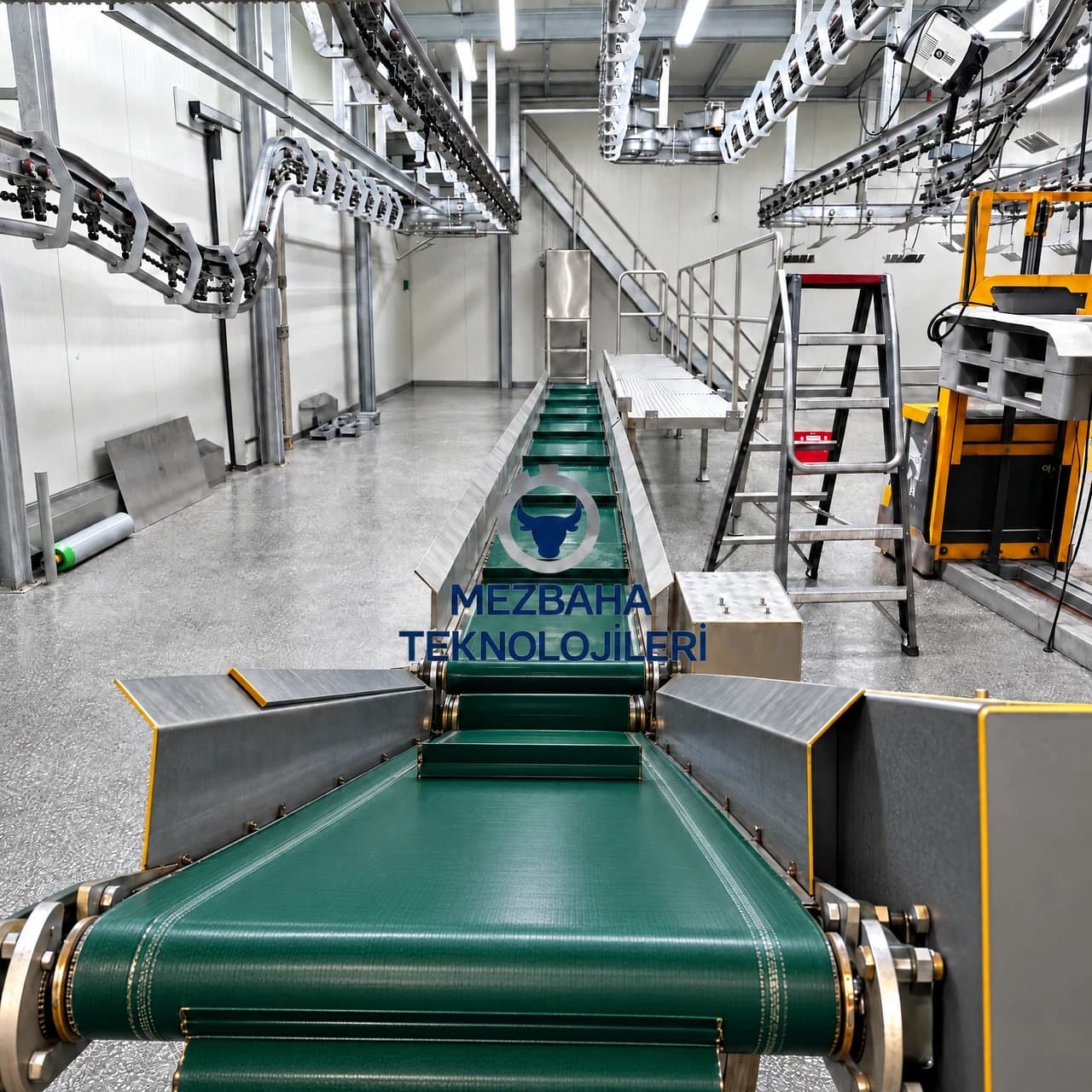
A sheep processing conveyor belt supports movement between selected work areas, but a successful lamb processing line requires more than a moving belt. Transfer heights, product-contact surfaces, cleaning access, operators and downstream handoffs all need to be coordinated with the overhead carcass transport system and the wider room layout.
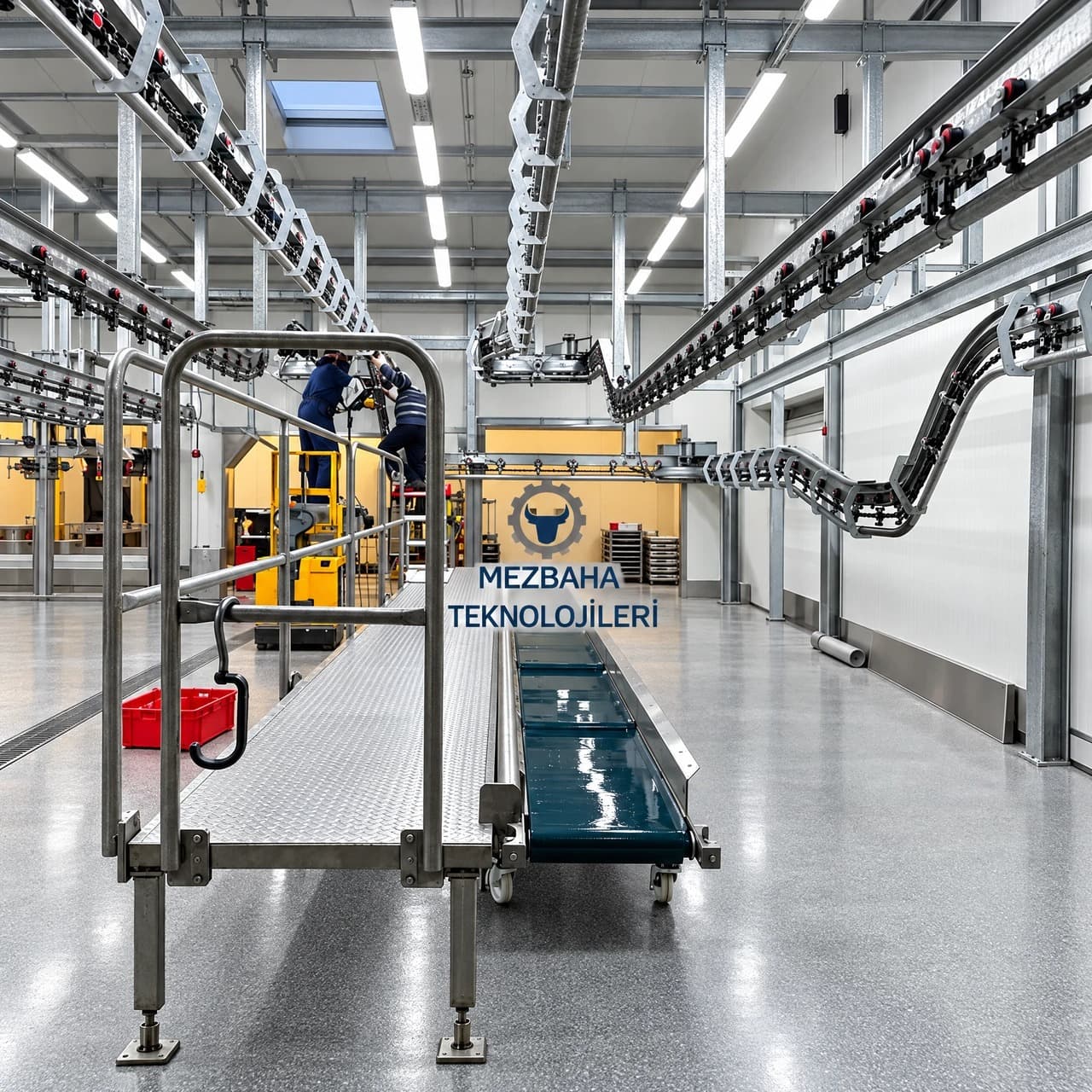
In the third supplied photograph, a green belt conveyor runs through a clean industrial room beneath overhead chain conveyors. A work platform, service stairs and other handling equipment are visible. The photo illustrates the challenge of integrating several transport systems in one space; it does not establish the belt’s food-contact certification or the plant’s processing capacity.
Distinguish belt transport from hanging carcass transport
An overhead system carries carcasses suspended from rails or hooks. A belt system provides a moving support surface for items suited to that transfer method. Their roles are different. A plant designer must determine exactly what the belt will carry, where the material enters, how it exits and whether the transfer belongs to an edible-product or inedible-material area.
Never assume that a green belt is suitable for direct contact with edible meat simply because it looks clean. Ask for documented material specifications, approved intended uses and the manufacturer’s cleaning instructions. Product-contact suitability is a specific technical and regulatory question.
Map every transfer point
At an interface between conveyors, small dimensional errors can create operational problems. Check infeed and discharge heights, required clearances, belt tracking, side guards and accessible removal of residues. Confirm whether a product transfer requires manual handling and whether that task is ergonomically acceptable.
Start with a written process flow diagram. Include normal movement, holding points, cleaning routes, inspection access and response to a stopped line. If the belt is integrated with overhead sheep carcass handling, describe how each transfer preserves the intended separation between product streams.
Design sanitation into the conveyor layout
Cleaning should influence the specification from the start. Ask about accessible rollers, belt edges, tensioning components, drainage and removal or lifting provisions where required. Check that adjacent platforms and machine guards do not block inspection or sanitation. Establish procedures for cleaning and maintenance consistent with the equipment supplier’s instructions and the plant’s sanitation program.
For federally inspected meat establishments in the US, 9 CFR Part 416 addresses sanitation, including equipment and utensils, and 9 CFR Part 417 addresses hazard analysis and HACCP systems. Plant-specific hazard analysis and written controls remain the operator’s responsibility. A conveyor image cannot demonstrate compliance.
Avoid bottlenecks through coordinated equipment selection
The useful speed of a belt is not automatically the useful output of the whole line. Review available floor space, operator staffing, upstream cycle times and downstream receiving capacity. Where an overhead chain line and a belt line interact, the sequence should be tested against realistic operating scenarios, including sanitation breaks and unexpected stops.
For a project-specific quotation, supply room drawings, intended transported material, expected operating conditions, transfer locations, cleaning regime and control requirements. Ask which components, guarding, supports, electrical connections and supporting documentation are included.
Maintenance and inspection checklist
Before accepting a design, confirm access to bearings and rollers; provisions for safe isolation; adjustment of belt tension and tracking; replacement-part availability; corrosion protection; and the cleaning plan for areas beneath and around the belt. Consider how maintenance can be performed without creating contamination risks for adjacent processing areas.
Mezbaha Teknolojileri’s Sheep Processing Conveyor product page describes the associated overhead carcass conveyor category. The supplier should confirm the exact belt configuration and intended handling application separately; the two transport types should not be presented as identical equipment.
Frequently asked questions
Is a belt conveyor the same as a sheep carcass overhead rail?
No. A belt carries material on a moving surface, while an overhead rail supports suspended carcasses. They can form parts of one facility but serve different functions.
Is every plastic conveyor belt food-contact suitable?
No. Suitability depends on the belt material, intended use, applicable requirements and documented specifications.
Why coordinate belt and overhead conveyor layouts?
Shared access, transfer points, cleaning routes and operating sequences can affect the overall efficiency and safety of a processing room.
Integrate your sheep processing line intelligently
Contact Mezbaha Teknolojileri with your plant drawing and transfer requirements to discuss how overhead handling, belt conveying and workstations can be coordinated in a complete lamb processing workflow.
Technical references: 9 CFR Part 416 — Sanitation; 9 CFR Part 417 — HACCP.