Overhead Meat Rail System: A 3D Carcass Conveyor Checklist
An engineering-oriented guide to rail routes, powered carcass conveyors, structural coordination and supplier RFQ questions.
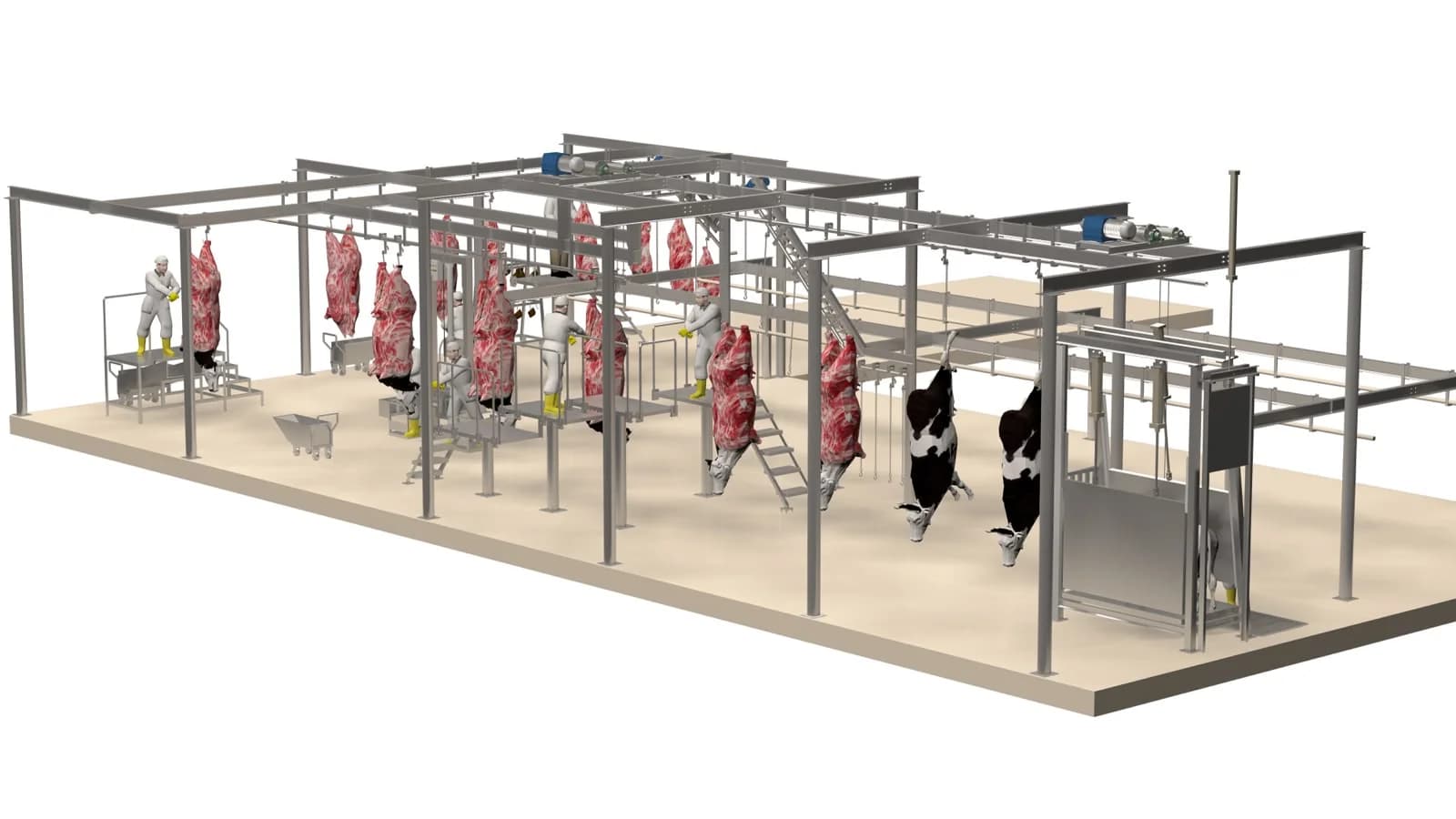
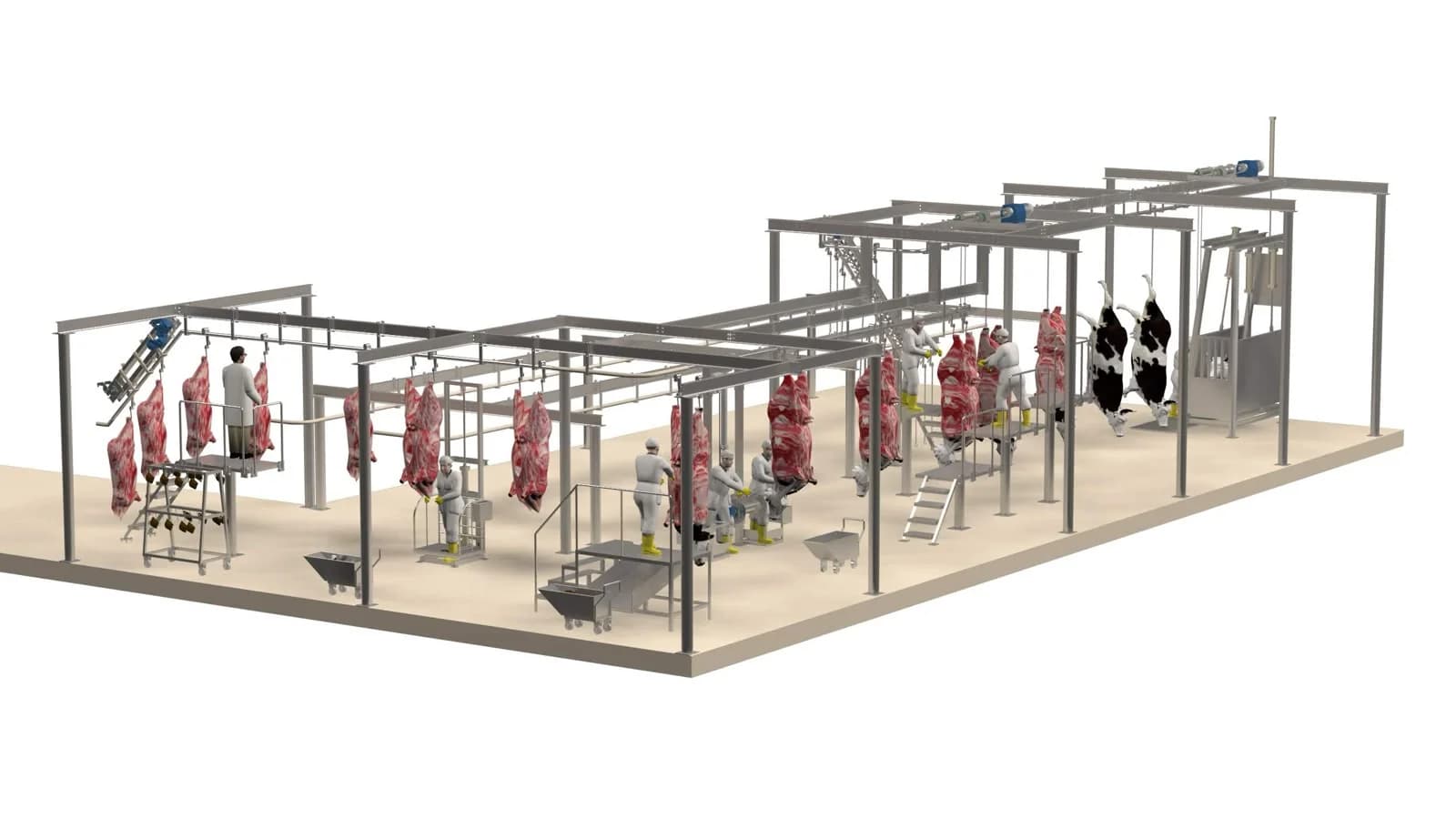
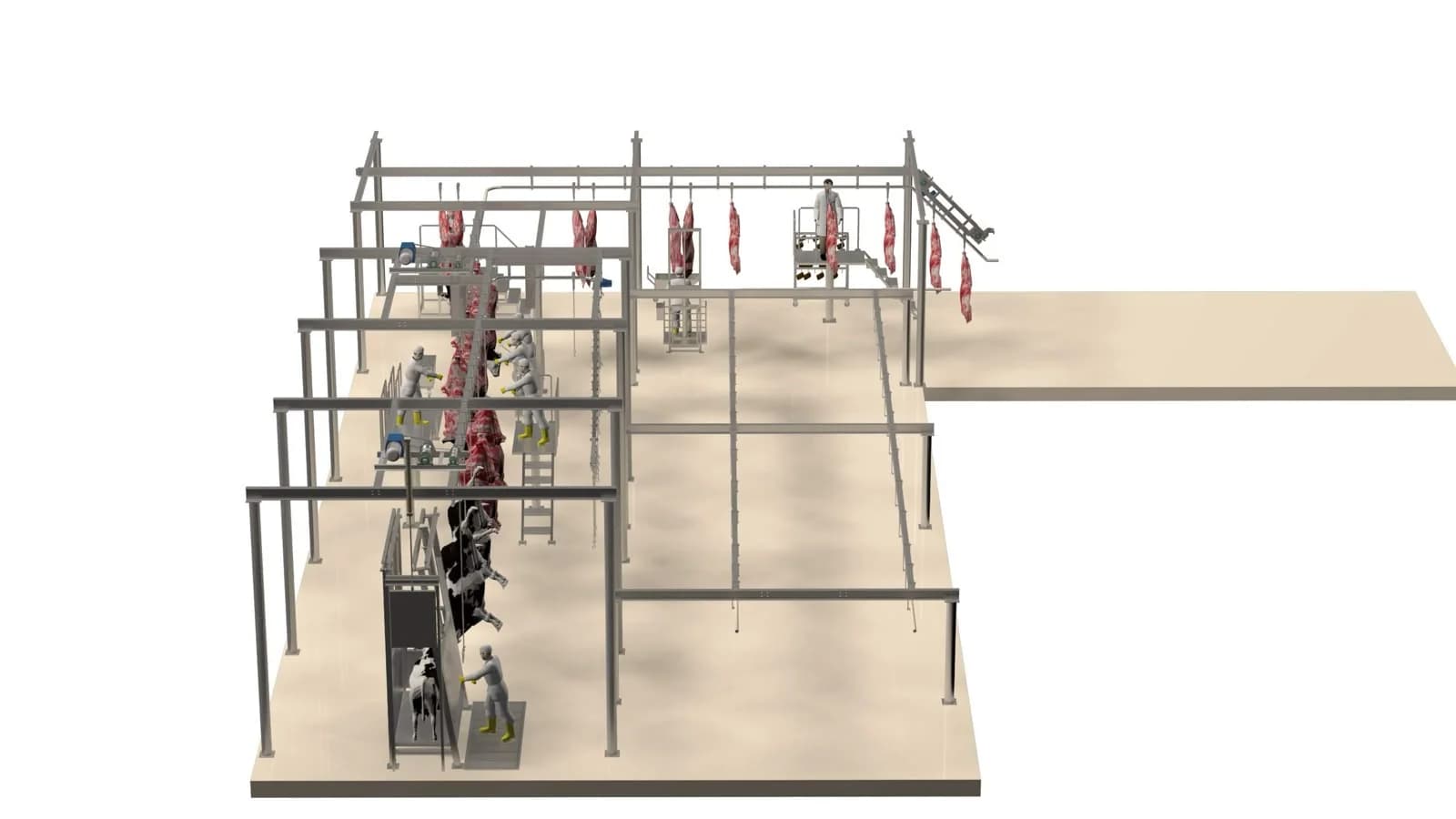
An overhead meat rail system connects individual cattle dressing stations into a coordinated line. In a beef slaughterhouse, the discussion is not only about which rail profile or motor to buy; it is about structural supports, hooks, transfer points, conveyor drives, service access and the available room geometry. The second supplied 3D rendering shows a conceptual beef processing installation with multiple rail runs, elevated supports and carcasses at several stations. It is not evidence of an installed system's capacity or certification.
Trace the complete carcass path
Begin by drawing the route from the initial transfer location to each dressing and inspection station and onward to the next approved handling area. On the 3D model, mark direction of travel, rail junctions, potential holding positions and access for operators and maintenance. A beef carcass conveyor layout should explain the function of each line segment, not merely show metal suspended from the roof structure.
Look carefully at changes in direction and elevation. Those interfaces often need more coordination than long straight runs. Confirm how hooks and carriers negotiate transitions, how loads are transferred and how the line behaves during a stop.
Specify loads and supports with qualified engineers
The illustration shows overhead steel framing, but the picture cannot establish allowable working load. The design must consider carcass mass range, carrier and rail self-weight, dynamic effects, anchoring, support spacing, corrosion environment and any seismic or other structural criteria that apply to the site. Qualified engineers must check the building and supports together.
Do not assume that a nominal rail load is sufficient for the complete line. Ask suppliers for engineering assumptions, component ratings and evidence that proposed equipment matches the operating envelope.
Powered vs. manual carcass movement
Depending on the project, carcasses may travel on manual rail sections, powered conveyors or a combination. Powered sections can provide controlled movement between workstations, but require properly selected drives, guards, controls, stopping logic and maintenance provisions. Manual sections still require clear routes, safe handling practices and ergonomic assessment.
A useful vendor comparison for slaughterhouse overhead conveyor systems should include drive position, anticipated line speed range, hook/carrier compatibility, control interfaces, cleaning access and provisions for isolating energy during maintenance. A model image cannot prove any of those specifications.
Coordinate rail spacing and workstations
Carcass spacing should be set by process needs, operator clearance and station cycle times—not guessed from a 3D image. Review how hanging carcasses interact with platforms, adjacent rails, moving components, columns and walkways. Consider inspection holds and buffer locations so one interruption does not automatically block every nearby workstation.
In the conceptual rendering, the rails pass through several work areas. This is precisely why a shared engineering review of support steel, processing platforms and overhead equipment is valuable before the final building layout is frozen.
Build hygiene and maintenance into the design
Rail systems operate in challenging washdown environments. Selection should address material suitability, corrosion protection, cleanability, lubrication control, drainage and access to high-level components. Sanitation teams need reachable surfaces and documented cleaning procedures; maintenance teams need safe access to motors, chains, switches and carriers.
In US establishments, the process design must fit the facility's sanitary practices and the applicable inspection framework. USDA-FSIS compliance cannot be inferred from a product rendering and should not be claimed without site-specific evidence.
Questions to send with a rail-system RFQ
Provide the intended carcass weight range, target head-per-hour rate, architectural and structural drawings, processing sequence, rail elevation constraints, power/control expectations and the handoff points to downstream rooms. Request a marked-up layout plus a list of exclusions and structural assumptions. This makes supplier proposals more comparable and reduces later interface surprises.
Buyer FAQ
Does a powered conveyor always outperform a manual rail? No. Suitability depends on capacity, line configuration, operator tasks, controls and maintenance capability.
Can rail length determine plant capacity? Not by itself. Station cycle time, spacing, transfers, downstream capacity and operating procedures also matter.
Should rail design be complete before platform selection? Both systems should be coordinated together because elevations and clearances affect each other.
Review your overhead rail concept
Explore the company's cattle processing line and share your floor plan, carcass handling requirements and anticipated throughput with Mezbaha Teknolojileri for a project-specific discussion. For a general introduction, see the existing cattle conveyor and rail systems article.
Related pages
- Product page: Cattle Processing Line
- Product page: Monorail and Twin Rail Systems
- Product group: Cattle Slaughterhouse Equipment
- Cattle Slaughter Line Process Flow: Planning Every Transfer in 3D
- Slaughterhouse Work Platform Layout: Operator Access in a 3D Beef Line
- Cattle Slaughter Line Conveyor and Rail Systems: Safe Carcass Transport in Modern Slaughterhouses
- How to Plan Carcass Processing Stations in Modern Slaughterhouses